Roof Replacement Cost in Oklahoma City 2026
Pricing · 2026-08-10 · National Roofers Team · 18 min read
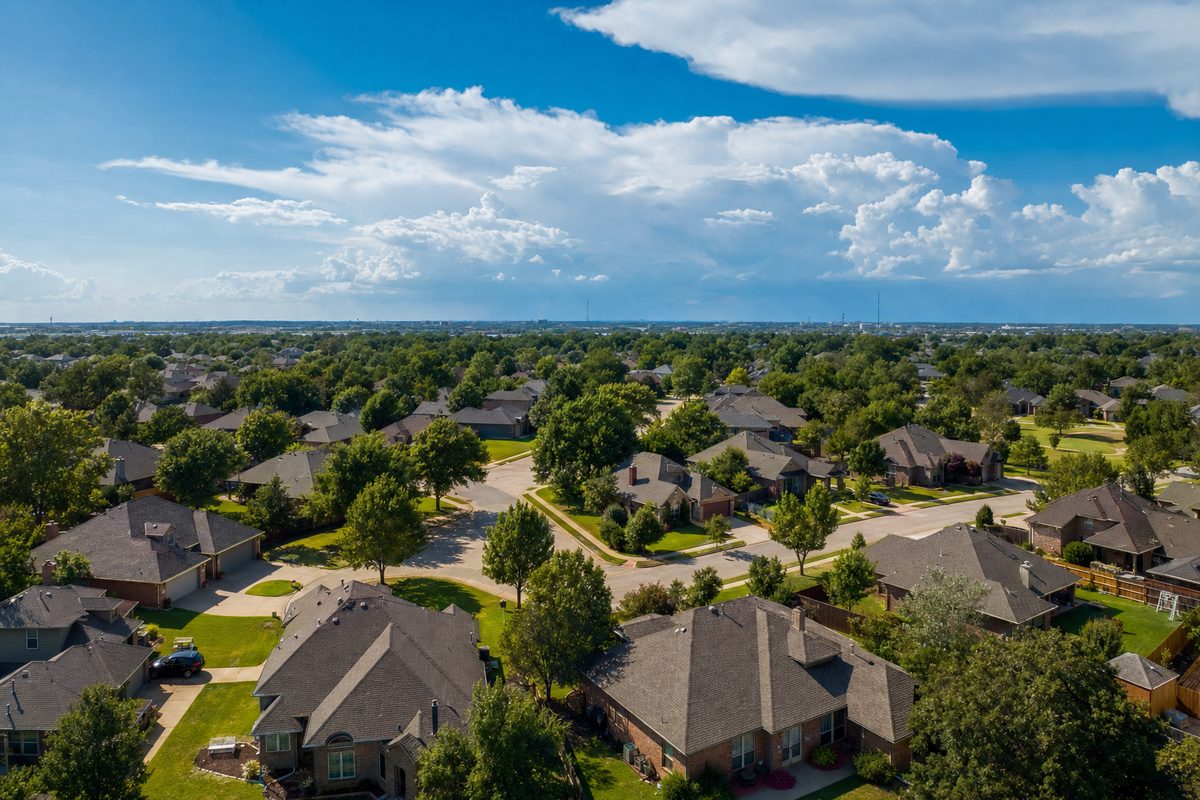
A full roof replacement in Oklahoma City typically costs $8,500-$18,000 in 2026. See real prices by roof size and material, the current city permit fee, and how OKC wind and hail change a job.
Oklahoma City Roof Replacement Cost at a Glance
A full roof replacement in Oklahoma City typically costs $8,500-$18,000 in 2026. For a typical 2,000 square foot home, the roof surface usually works out to about 22 squares once pitch and waste are factored in. An architectural-shingle replacement on that size roof commonly lands around $10,000-$15,000 when the roof has a single old layer, an ordinary pitch, and no major decking repair. The low end fits a smaller, simple roof. The high end reflects a bigger or steeper roof, more roof penetrations, or a higher-end material. Square footage of the house is not the same as square footage of the roof, so a measured quote based on your actual address is more useful than a rule of thumb. You can get an instant, satellite-measured quote without scheduling an in-home sales visit.
| Roof area | Approximate house footprint | Typical total |
|---|---|---|
| 16 squares | 1,300-1,600 sq ft | $8,500-$11,000 |
| 22 squares | About 2,000 sq ft | $10,000-$15,000 |
| 28 squares | 2,300-2,700 sq ft | $13,000-$17,500 |
| 35 squares | 3,000+ sq ft | $15,500-$18,000+ |
Cost by Material in Oklahoma City
Architectural asphalt is the practical default for most Oklahoma City homes because it balances upfront cost against the wind and hail exposure the metro sees most years. Metal shingle and standing-seam systems cost more per square but hold up well against wind uplift, which is a real consideration in a market that sits inside Tornado Alley. Cedar and clay tile are available but uncommon locally and priced accordingly. The ranges below are 2026 planning ranges for a roughly 22-square roof under ordinary installation conditions. A complex roofline, an extra tear-off layer, or decking repairs found after tear-off can move any material above its range. For a longer comparison of two of the most common choices, see asphalt versus metal roofing.
| Material | Quote-engine material price per square | Typical installed total |
|---|---|---|
| 3-Tab asphalt | $85 | $8,500-$12,000 |
| Architectural asphalt | $120 | $10,000-$15,000 |
| Designer asphalt | $165 | $12,500-$17,500 |
| Metal shingle | $280 | $15,500-$23,000 |
| Standing-seam metal | $320 | $17,500-$26,500 |
| Clay tile | $680 | $29,000+ |
How the Per-Square Math Works
A roofing square is 100 square feet of roof surface. National Roofers' quote engine starts architectural asphalt materials at $120 per square, plus $85 for labor, $45 for tear-off, and $28 for underlayment. That is a $278-per-square baseline across those four line items, or $6,116 across a 22-square roof. The finished total is higher because it also includes starter strip and ridge cap, flashing at valleys and penetrations, ventilation components, disposal, the city permit, contractor overhead, and any decking repair found once the old roof comes off. A per-square price is a useful way to compare bids, but it is not the final number on its own. See roof replacement cost per square foot for how squares convert to square footage.
| Component | Price per square | 22-square baseline |
|---|---|---|
| Architectural asphalt material | $120 | $2,640 |
| Labor | $85 | $1,870 |
| Tear-off | $45 | $990 |
| Underlayment | $28 | $616 |
| Subtotal for these components | $278 | $6,116 |
Why Oklahoma City Labor Runs Below National Averages
Labor is typically the single biggest swing factor in any roofing quote, and it is also where Oklahoma City tends to run favorably compared with coastal and high-cost metro markets. General construction wages and the local cost of doing business in central Oklahoma sit below markets like Denver, Chicago, or the coasts, and that shows up directly in the labor line of a roofing quote rather than in the material line, since shingles, underlayment, and metal panels are priced nationally by the manufacturer regardless of where the job is. A homeowner comparing an Oklahoma City bid against a number they saw quoted for a friend or relative in a higher-cost state should expect the labor and installed-total side of the bid to run lower here for a similar roof, even though the material price per square is the same everywhere National Roofers operates. This is one reason a 22-square architectural-asphalt roof lands nearer the middle of the $10,000-$15,000 range in Oklahoma City rather than pushing toward the top of it, all else being equal. It does not mean every bid will be cheap. A steep, cut-up roof with a lot of flashing work still takes the same number of labor-hours here as anywhere else; it is the hourly rate underneath those hours that tends to be lower.
| Factor | Effect in Oklahoma City | Why |
|---|---|---|
| Base labor rate | Below many higher-cost metros | Lower regional cost of construction labor and business overhead |
| Material price per square | Same nationally | Set by manufacturer pricing, not local labor market |
| Roof complexity (pitch, cuts, penetrations) | Same hours required regardless of city | Labor-hours depend on the roof, not the ZIP code |
| Net effect on a standard 22-square job | Tends toward the middle of the range, not the top | Lower hourly labor cost offsets national material pricing |
What Drives an Oklahoma City Quote Up or Down
Roof pitch is the first variable. A steep roof takes longer to tear off and install safely, and that adds labor hours regardless of material. The number of existing shingle layers matters too; a second layer means more tear-off time and more disposal weight. Decking condition is discovered, not assumed: a contractor cannot know how much plywood needs replacing until the old shingles are off, so that cost should be priced as a stated allowance or a documented change order, not folded silently into the final bill. Roof access affects labor time as well, particularly on homes with mature trees, narrow side yards, or a detached garage that needs its own tear-off and disposal run. Chimneys, skylights, plumbing vents, and HVAC penetrations each need flashing work, and more of them means more cutting and detailing time. None of this is unique to Oklahoma City, but it explains why two roofs of the same square footage can price differently.
Oklahoma City Climate and What It Does to a Roof
Central Oklahoma sits in a part of the country that regularly produces severe thunderstorms, and the physical effects on a roof are well documented independent of any particular storm event. Hail is frequent in this region; the area where Oklahoma, Kansas, and Texas meet is sometimes called hail alley and averages roughly seven to nine hail days a year, among the highest concentrations in the country, according to the National Severe Storms Laboratory. Hail impact bruises or fractures the mat of asphalt shingles, which can shorten service life even when the damage is not visible from the ground. Straight-line wind and tornado-adjacent wind gusts are the second major stress: uplift at the roof edge, ridge, and any loose or under-nailed shingle is the most common failure point in a wind event, which is why nailing pattern and shingle wind rating matter as much as the shingle brand. Oklahoma also swings through a wide annual temperature range, from summer heat that softens asphalt to winter cold and periodic ice storms that make shingles brittle, and repeated expansion and contraction across that range accelerates normal wear at seams, flashing, and sealant strips. None of this is a financial event on its own; it is simply the physical environment a roof in this metro has to perform in, and it is the reason material choice, fastening pattern, and flashing detail carry more weight here than in a milder climate.
Wind Rating and Nailing Pattern: Why It Matters More Here
The building code sets a baseline for how a shingle roof has to be fastened, and the baseline changes with local wind design. Under the residential code, standard installation calls for a minimum of four nails per shingle, placed in the shingle's nailing strip. In locations where the basic design wind speed exceeds 110 mph, or that fall in the code's higher wind design category, the requirement rises to six nails per shingle. That threshold is tied to the specific project location's design wind speed rather than to the state as a whole, so the applicable pattern should be confirmed for the address, not assumed. A 6-nail pattern adds two additional fastening points per shingle at manufacturer-marked locations, and using a standard shingle without marking those extra nail spots correctly is a common inspection failure point. Many manufacturers publish a wind-rated version of their shingle line specifically for higher nail counts and higher rated wind speeds, and a contractor working in this market should be able to state which nailing pattern and which shingle wind rating they are installing, not just the shingle color and style. Given how often this metro sees straight-line wind and severe thunderstorm gusts, asking for this detail up front is one of the more useful questions a homeowner can ask, more useful than asking about brand name alone.
Oklahoma City Neighborhoods and Housing Stock
Roof style and age vary across the metro more than a single citywide average suggests. Nichols Hills has older, larger homes with more varied rooflines, dormers, and detailing, which generally means more cutting and flashing work per square. Edmond and Norman mix established neighborhoods with newer subdivisions and tend to have a wider range of roof sizes and pitches. Moore, Yukon, and Mustang have grown quickly with more standardized suburban construction, which often means simpler gable and hip layouts that install faster per square. Midwest City, Bethany, and The Village have older housing stock with smaller footprints but sometimes tighter lot access. Deer Creek, on the northwest side of the metro, has newer construction with straightforward rooflines similar to other fast-growing suburbs. None of this fixes a price by neighborhood; a two-story home with a cut-up roofline in a newer suburb can cost more to reroof than a simple ranch roof in an older neighborhood. Roof measurement and layout, not the neighborhood name, determine the quote.
| Area | Typical housing age | Roof layout tendency |
|---|---|---|
| Nichols Hills | Older, established | More dormers and detailing |
| Edmond | Mixed older and newer | Wide range of pitches and sizes |
| Norman | Mixed, college-town mix | Wide range, more rental stock |
| Moore, Yukon, Mustang | Newer suburban growth | Simpler gable and hip layouts |
| Midwest City, Bethany, The Village | Older, smaller footprints | Smaller roofs, tighter access |
| Deer Creek area | Newer construction | Straightforward suburban rooflines |
Permits and Local Requirements
The City of Oklahoma City requires a roofing permit for roof removal, repair, or replacement on single-family homes and duplexes within city limits, a requirement that took effect August 1, 2025 following adoption by the Oklahoma City Council in June 2025, according to the City of Oklahoma City. The permit fee is $94.50, and permits are typically issued the same day. A permit is not required for maintenance work covering 500 square feet or less, or for new construction. Homeowners and contractors can apply online at okc.gov/access or in person at the city's Development Center at 420 W. Main St., and can request inspection online, by text, or through an automated phone system once the permit is issued. City inspectors check roof condition, flashing, drainage, installation, and code compliance before signing off. If your address falls in Edmond, Norman, Moore, or another surrounding city rather than inside Oklahoma City limits, that jurisdiction's own building department sets its own permit process and fee, so confirm which office actually covers your address before assuming the OKC figure applies. Contact us for a quote and we will confirm the permitting jurisdiction for your address as part of the process.
Oklahoma's State Roofing Contractor Registration
Beyond city permits, Oklahoma has a state-level requirement that applies specifically to roofing contractors. Under the Roofing Contractor Registration Act, any resident or nonresident contractor performing roofing-related services in Oklahoma must hold a valid registration issued by the Construction Industries Board, or CIB, according to the Oklahoma Construction Industries Board. Operating without this registration is a misdemeanor punishable by a fine of up to $500, enforced by the local district attorney's office. To obtain the registration, a contractor has to submit an application, prove lawful presence, and show evidence of at least $500,000 in general liability insurance for residential work, along with proof of workers' compensation coverage or a valid exemption. Contractors doing commercial roofing work need a separate commercial endorsement, which requires passing an exam and carrying at least $1,000,000 in commercial general liability coverage. Registration and any commercial endorsement must be renewed annually. This is a straightforward way for a homeowner to screen a contractor before signing anything: ask for the CIB registration number and confirm the contractor carries liability and workers' compensation coverage, which is required for the registration to be valid in the first place.
How to Verify a Contractor's Oklahoma Registration
The Construction Industries Board maintains a public license and registration search at its verification portal, where a search by contractor or business name returns registration status, according to the Oklahoma CIB license verification tool. Searches must include at least three characters, and an asterisk can be added after a partial name to search for a surname or unknown characters. The CIB notes that the online tool is provided for convenience and may not always be fully current, so for a firm confirmation, homeowners can call the CIB office directly at 405-521-6550 to verify an individual contractor's registration status before signing a contract. Doing this before work begins costs nothing and takes a few minutes, and it is a more useful screening step than checking online reviews alone, since it tells you whether the company is legally allowed to perform roofing work in Oklahoma in the first place. If you would rather understand how to read and compare bids once you have confirmed registration, see how to choose the right roofing contractor.
Best and Worst Months to Replace a Roof in Oklahoma City
Spring and early summer bring the highest volume of severe thunderstorm activity in this region, which means more roofs needing attention at once and longer scheduling windows during peak season. Late summer through fall tends to bring more predictable weather and more contractor availability, which can mean a faster start date once you have a signed scope. Winter is workable for roofing in Oklahoma City, but ice storms and occasional hard freezes can pause work for safety reasons, and cold asphalt shingles are more brittle to handle during tear-off and installation. If your roof is not in urgent need of replacement, scheduling in the fall or a mild stretch of late winter can mean a shorter wait for a crew than trying to book during the height of spring storm season. If the roof is actively leaking or showing exposed decking, timing takes a back seat to getting it addressed.
Signs You Need Replacement Rather Than Repair
Granule loss heavy enough to show bald patches or granules collecting in gutters signals the shingle's UV protection is failing. Shingles that are cupping, curling at the edges, or cracked across multiple slopes point to age and weathering rather than a single damaged spot. Soft or spongy decking underfoot, visible daylight through the attic roof boards, or staining on interior ceilings all indicate moisture has already reached the structure. A roof older than its expected material lifespan that is also showing multiple smaller issues at once is usually a better candidate for full replacement than a series of repeated patch repairs. A roof with one isolated issue, like a single damaged area from a fallen branch, a slipped shingle, or a failed pipe boot, is often a repair candidate instead. For a fuller walkthrough of what to look for before deciding, see signs your roof needs replacement.
How to Compare Bids So They Are Actually Comparable
Ask every contractor for the same set of specifics: the measured square count for your roof, the exact shingle product and its wind rating, the nailing pattern being used, tear-off layers included, underlayment type, flashing scope at valleys and penetrations, ventilation plan, and how the permit is being handled. A bid that is unusually low compared to others may be omitting one of these items, which then shows up later as an add-on. A bid that is unusually high should be able to explain why in terms of roof complexity, decking allowance, or a premium material, not just a higher markup. Two bids for the same 22-square architectural-asphalt roof should be within a reasonable range of each other once scope is matched; if they are not, the difference is almost always in what is or is not included, not in the shingle itself. For more detail on reading a quote line by line, see understanding your roofing quote.
Getting a Measured Price Without an In-Home Visit
National Roofers measures roofs remotely using satellite and address data rather than sending a salesperson to walk your roof first. Entering your address at the instant quote page returns a price based on your home's actual measured roof area within a few minutes, without scheduling an in-home appointment. That measured number is a strong starting point, but a final scope should still confirm layer count, decking condition, and permit handling once a crew has assessed the roof in person before work begins. If you want to understand how that process works end to end, see how to get a roof quote without letting anyone in, or read about what a roofing contractor actually does between the quote and the finished job.
Frequently Asked Questions
How much does a new roof cost in Oklahoma City?
A full roof replacement in Oklahoma City typically costs $8,500-$18,000 in 2026. A roughly 22-square architectural-asphalt roof on a 2,000 square foot home commonly falls around $10,000-$15,000. Roof pitch, shingle layers, decking condition, material choice, and nailing requirements can all move the final price.
How much does a 2,000 square foot roof cost in Oklahoma City?
A 2,000 square foot house usually has about 22 squares of roof surface once pitch and waste are measured. For architectural asphalt, a typical Oklahoma City replacement runs $10,000-$15,000, assuming one tear-off layer and no major decking replacement. A steeper or more complex roof can run higher.
Do I need a permit to replace a roof in Oklahoma City?
Yes. The City of Oklahoma City requires a roofing permit for reroofing single-family homes and duplexes within city limits, effective August 1, 2025. The fee is $94.50 and permits are typically issued the same day, according to the City of Oklahoma City. A permit is not required for maintenance work of 500 square feet or less. If your address is in a surrounding city like Edmond, Norman, or Moore, that city's building department sets its own fee and process.
Do Oklahoma roofing contractors need a state license?
Oklahoma requires roofing contractors to hold a state registration through the Construction Industries Board under the Roofing Contractor Registration Act, rather than a general contractor license. Registration requires proof of at least $500,000 in general liability insurance and workers' compensation coverage or an exemption, according to the Oklahoma Construction Industries Board.
How do I check if a roofing contractor is registered in Oklahoma?
You can search by contractor or business name using the Oklahoma CIB license verification tool. Searches require at least three characters. Because the CIB notes the online tool may lag behind real-time changes, you can also call the CIB directly at 405-521-6550 to confirm a contractor's current registration status before signing a contract.
Why does hail matter for roofing in Oklahoma City if this page has no insurance content?
Hail is discussed here only as a physical stress on roofing materials. The area where Oklahoma, Kansas, and Texas meet is sometimes called hail alley and sees roughly seven to nine hail days a year on average, among the highest rates in the country, according to the National Severe Storms Laboratory. Repeated hail impact can bruise or fracture the shingle mat, which is a durability and material-choice question, not a financial one.
What is the difference between 4-nail and 6-nail shingle installation?
Standard asphalt shingle installation requires a minimum of four nails per shingle placed in the shingle's nailing strip. In areas with a basic design wind speed above 110 mph or in the code's higher wind design category, six nails per shingle are required instead. The correct pattern depends on the specific project location's design wind speed, so it should be confirmed for your address rather than assumed.
Is metal roofing worth it in Oklahoma City given the wind?
Metal costs more upfront than architectural asphalt, with a roughly 22-square standing-seam roof typically planning at $17,500-$26,500. Its main advantage in this market is wind and impact durability rather than upfront savings. Whether it is worth the added cost depends on how long you plan to own the home and how much you value that added durability.
Why is Oklahoma City roofing sometimes cheaper than other markets?
Labor is typically the largest variable cost in a roofing job, and central Oklahoma's construction labor rates and general cost of doing business tend to run below higher-cost metro markets. Material prices are set nationally and do not change by city, so the savings show up mainly in the labor portion of an installed total rather than in the shingle price itself.
How can I get an Oklahoma City roof quote without a sales visit?
Enter your address to get an instant satellite-measured quote. National Roofers measures the roof remotely using your address and returns a price in a few minutes without an in-home sales appointment. A final scope should still confirm layer count, decking condition, and permit handling once a crew evaluates the roof in person.