Roof Replacement Cost in Austin 2026
Pricing · 2026-08-10 · National Roofers Team · 21 min read
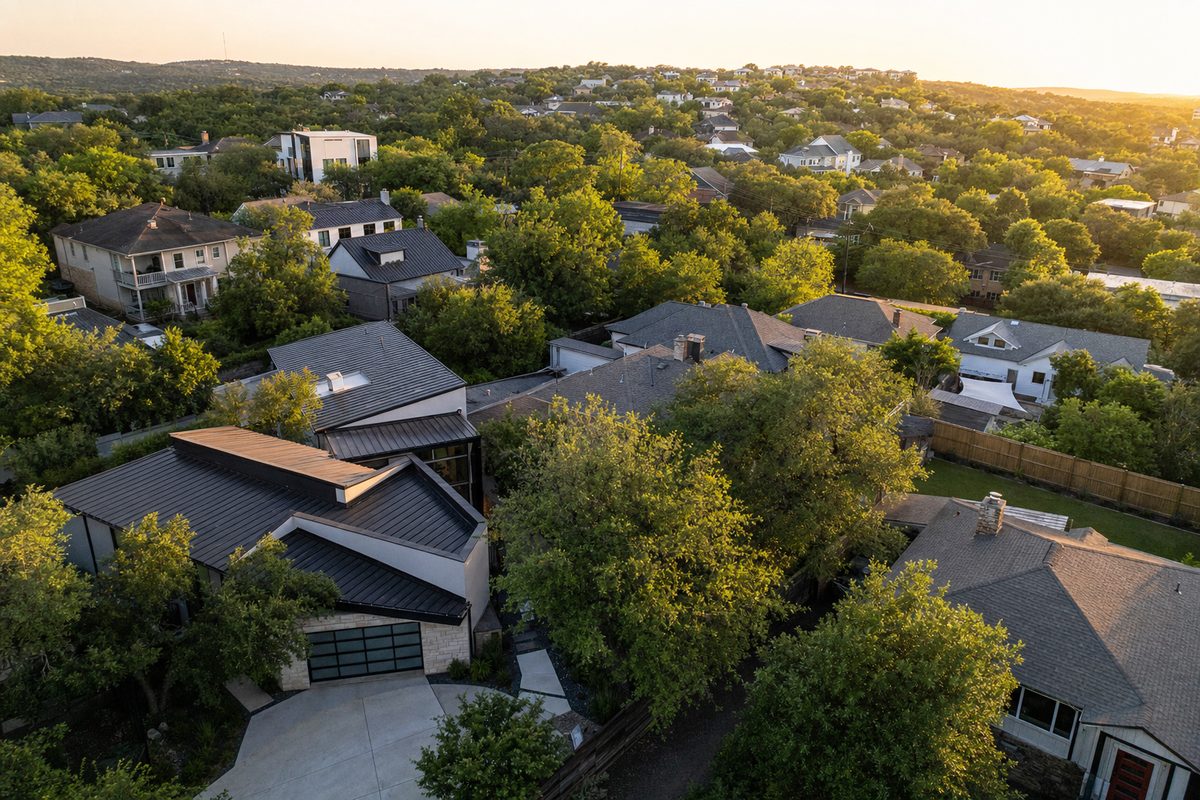
Austin roof replacement costs typically run $9,000-$20,000 in 2026, with standing-seam metal often $18,000-$29,000. See prices by size and material, permit rules, and what Austin's climate and modern housing stock change.
Austin Roof Replacement Cost at a Glance
A full roof replacement in Austin typically costs $9,000-$20,000 in 2026, with a standing-seam metal roof commonly running $18,000-$29,000 once a home moves toward that material. For a typical 2,000 square foot home, the roof surface usually works out to about 22 squares after pitch and waste are measured. An architectural-shingle replacement on that size roof commonly lands at $10,500-$16,000, slightly above the price a similar roof would run in flatter, less labor-constrained Texas markets, because Austin labor and permitting logistics run higher than the state average. The low end fits a simple single-story home with an ordinary pitch. The high end reflects a steeper or more cut-up roofline, a second layer to tear off, or a move to metal. Austin also has an unusually large share of low-slope, mixed-pitch, and standing-seam roofs tied to its modern and architect-designed housing stock, which changes the math for a meaningful slice of the market. Square footage of living space is not the same as roof area, so use an address-based measurement before comparing bids. You can get an instant satellite-measured quote for your Austin address without scheduling an in-home sales visit.
| Roof area | Approximate house footprint | Typical total |
|---|---|---|
| 16 squares | 1,300-1,600 sq ft | $8,500-$11,500 |
| 22 squares | About 2,000 sq ft | $10,500-$16,000 |
| 28 squares | 2,300-2,700 sq ft | $14,000-$19,500 |
| 35 squares | 3,000+ sq ft | $16,500-$20,500+ |
Cost by Roofing Material in Austin
Architectural asphalt remains the most common replacement material for Austin's conventional pitched roofs, offering a reasonable balance between upfront cost and resistance to sun and hail wear. Standing-seam metal has moved from a niche choice to a mainstream one in Austin because so much of the newer and architect-designed housing stock uses low-slope or mixed-pitch rooflines where metal performs and looks better than shingles. Metal shingles sit between architectural asphalt and standing-seam in both appearance and price. Cedar and clay tile appear occasionally on older estate homes and Spanish Colonial Revival houses in neighborhoods like Tarrytown, but they are far less common than asphalt or metal across the metro as a whole. The ranges below reflect a roughly 22-square roof under ordinary conditions; a steep or complex roofline moves any material toward the top of its range or above it. For a longer side-by-side comparison, see asphalt versus metal roofing.
| Material | Quote-engine material price per square | Typical installed total |
|---|---|---|
| 3-Tab asphalt | $85 | $8,500-$12,500 |
| Architectural asphalt | $120 | $10,500-$16,000 |
| Designer asphalt | $165 | $13,000-$19,000 |
| Metal shingles | $280 | $16,500-$25,000 |
| Standing-seam metal | $320 | $18,000-$29,000 |
| Clay tile | $680 | $32,000+ |
How the Per-Square Math Works
A roofing square is 100 square feet of roof surface. National Roofers' quote engine starts architectural asphalt materials at $120 per square, plus $85 for labor, $45 for tear-off, and $28 for underlayment. That is a $278-per-square baseline for those four components, or $6,116 across 22 squares. The real installed total is higher because it also includes starter and ridge materials, flashing, ventilation, disposal, permit handling, contractor overhead, and any repair work found once the old roofing comes off. Austin's labor line tends to run above the statewide baseline for the reasons explained later in this page, which is one reason the installed total sits closer to the higher end of a typical Texas range even when the material choice is ordinary. See roof replacement cost per square foot for the conversion between squares and square feet.
| Component | Price per square | 22-square baseline |
|---|---|---|
| Architectural asphalt material | $120 | $2,640 |
| Labor | $85 | $1,870 |
| Tear-off | $45 | $990 |
| Underlayment | $28 | $616 |
| Subtotal for these components | $278 | $6,116 |
What Actually Drives an Austin Roof Price Up or Down
Pitch is the biggest single factor. A steep roof slows every stage of the job, from tear-off to fastening, and increases the fall-protection setup a crew has to build. Layers matter too: many older Austin homes carry one shingle layer, but some have two, and a second layer adds disposal weight and tear-off time. Decking condition is discovered, not estimated, once the old roofing is removed. Central Texas homes on older streets can have plank decking or sheathing that has softened around plumbing vents and valleys, and replacing damaged sections is priced as its own line item rather than folded into a flat number. Access changes cost as well: a downtown lot with mature oak trees crowding the roofline and a narrow driveway takes longer to stage material and haul debris than a suburban lot with clear truck access. A mixed-pitch roof, common on the newer architect-designed homes discussed below, adds transitions, valleys, and flashing details that a single-plane gable roof does not have. None of these factors are unique to Austin, but the combination of older housing stock, heavy tree canopy, and a large share of architecturally complex modern homes means Austin sees more of them at once than a typical flat suburban market.
Austin Climate and What It Does to Roofs
Austin roofs spend more of the year under direct, intense sun than roofs in most of the country, and summer surface temperatures on a dark asphalt roof regularly climb well above the surrounding air temperature. That heat cycle, repeated for months, dries out asphalt binder over time and can accelerate granule loss on an aging shingle roof. Central Texas also sits inside a recognized hail corridor: National Weather Service storm records compiled for the Austin area show measurable hail on roughly 20 days a year over the past decade, with the season concentrated from March through June and April and May typically the most active months, based on NOAA storm event data compiled by HailIndex. Hail this size can bruise or crack shingles and dent metal panels, which is a physical durability question that affects material choice and timing, not a financial one. Austin's tree canopy adds a separate mechanical stress. The city's live oak, cedar elm, and Ashe juniper cover shed limbs in wind events, and after the February 2023 ice storm, an assessment by the Texas A&M Forest Service found that roughly 31 percent of Austin's urban tree canopy was affected, with about 30 percent of total canopy area showing some degree of damage or stress, according to the Texas A&M Forest Service City of Austin Ice Storm Damage Assessment. That event followed the broader February 2021 winter freeze that affected the entire region with prolonged sub-freezing temperatures. Ice accumulation and falling limbs from both storms left physical wear on roofs across the metro: bent or punctured metal, cracked shingles, and debris impact around ridges and valleys. Because Austin's canopy is dense in older, established neighborhoods, homeowners there should expect more limb debris on the roof after any wind or ice event than a homeowner on a newer, more sparsely planted suburban lot.
Neighborhood and Housing-Stock Variation Across Austin
Roof cost varies by neighborhood mostly because roof design, age, and access vary, not because a ZIP code carries a fixed price. Hyde Park, one of Austin's oldest neighborhoods and a National Register historic district platted in 1891, is dominated by early bungalows along with Queen Anne and Tudor Revival houses, many with steep, cut-up rooflines and mature tree cover that slow tear-off and add flashing detail, according to the City of Austin's Hyde Park Local Historic District documentation. Travis Heights, a National Register historic district south of Lady Bird Lake, mixes 1920s and 1930s Craftsman bungalows with a growing number of architect-designed modern rebuilds on the same blocks, so roof style within a single street can range from a simple gable to a complex low-slope design. Tarrytown's housing stock spans 1920s Tudor Revival and Spanish Colonial Revival homes with steep, detailed rooflines through 1950s-1970s mid-century ranch houses with low or flat rooflines, plus newer custom construction, so pitch and material vary block by block. Mueller, a master-planned redevelopment on Austin's east side, was built to green building standards and features a high concentration of modern homes with straightforward rooflines and, frequently, standing-seam or low-slope metal. Circle C Ranch and Steiner Ranch are large master-planned communities in southwest and northwest Austin respectively, built mostly from the late 1980s through the 2000s, with conventional suburban roof pitches and homeowner association design guidelines that can restrict material and color choices. Round Rock, Cedar Park, Pflugerville, and Georgetown are separate incorporated cities in the surrounding metro with their own building departments and largely newer suburban housing stock; a reroof there follows that city's permit process rather than Austin's. Georgetown has grown quickly around large master-planned communities such as Sun City, an age-restricted community that expanded from roughly 940 residents in 1996 to more than 15,000 by 2021, according to Community Impact's reporting on Sun City's growth. Treat this as planning context, not a fixed surcharge. A measured roof and a written scope will always describe your actual job better than a neighborhood generalization.
| Area | Typical housing era | Common roof pattern |
|---|---|---|
| Hyde Park | 1890s-1930s bungalows, Queen Anne, Tudor Revival | Steep, cut-up gable roofs, mature tree cover |
| Travis Heights | 1920s-1930s bungalows plus modern rebuilds | Mixed: simple gables and complex low-slope infill |
| Tarrytown | 1920s revival homes through mid-century ranches and new custom builds | Wide range: steep Tudor rooflines to flat mid-century roofs |
| Mueller | 2000s-present planned redevelopment | Simpler rooflines, frequent low-slope and metal |
| Circle C Ranch, Steiner Ranch | Late 1980s-2000s master-planned suburbs | Conventional suburban pitches, HOA material rules |
| Round Rock, Cedar Park, Pflugerville, Georgetown | 1990s-present suburban growth, ongoing new construction | Standard suburban pitches, separate city permitting |
Why So Many Austin Roofs Are Low-Slope or Standing-Seam Metal
Austin has an unusually high concentration of modern and architect-designed homes compared with most Texas metros, and that shapes roofing costs in a way a generic price guide will miss. The city's mid-century modern building boom, led in neighborhoods like Rollingwood, Barton Hills, and pockets of Hyde Park and Tarrytown by architects working in the postwar decades, left a legacy of low-pitched and flat-roofed ranch houses still visible today. That aesthetic never went away. Contemporary Austin architecture, especially the Hill Country contemporary style popular in newer luxury construction, leans heavily on standing-seam metal paired with limestone and expansive glazing, and local architecture firms have continued that tradition into current new builds and renovations across the metro. A low-slope or mixed-pitch roof changes the cost conversation in two ways. First, it usually pushes the material choice toward standing-seam metal or a membrane system rather than asphalt shingles, because shingles are not rated for very low slopes. Second, it adds transition and flashing complexity that a single-pitch gable roof does not have, since a low-slope or mixed-pitch design often means multiple roof planes meeting at different angles. If your Austin home has this kind of roofline, get a quote based on your actual roof design rather than a generic per-square-foot number, and read architectural versus 3-tab shingles for background on how shingle types compare before assuming asphalt is the right category for your roof.
Austin Permits and Local Requirements
Austin treats residential re-roofing as a Minor Repairs building permit matter under the Development Services Department, and the city's official permit-types page lists roof work under that category rather than describing full re-roofing as exempt, according to Austin Development Services' Types of Permits page. Many straightforward re-roofs qualify for the city's Express Permit process, which the city states typically turns around in about one business day, though timing can differ if the property sits in a floodplain or historic district, per Austin's Express Permits page. Some limited re-roofing work is exempt from a permit altogether. The city's official exemption list states that replacing existing asphalt shingles with new asphalt shingles is exempt, as is replacing any roof covering that does not adversely affect the roof structure, unless the property sits in the Wildland-Urban Interface area and 50 percent or more of the roofing is being replaced, according to Austin's Work Exempt from Building Permits page. In practice, a straightforward like-for-like asphalt shingle replacement on a standard home may not require a permit at all, while a full tear-off to a different material, a large decking replacement, or work on a home in the Wildland-Urban Interface area is more likely to need one. Because the exemption depends on your project's specific scope and your property's zoning overlay, and because the city's published fee schedules do not post a single flat dollar figure for a standard residential reroof permit, confirm the current requirement and any fee directly with Austin Development Services or through the AB+C Portal before work begins. If your address falls in Round Rock, Cedar Park, Pflugerville, or Georgetown rather than the City of Austin, that city's own building department, not Austin's, sets the applicable permit process and fee.
Best and Worst Months to Replace a Roof in Austin
Late fall through early spring, roughly October through February, tends to be the calmer stretch for Austin roofing schedules because it falls outside both the peak hail season and the hottest stretch of summer. Crews can work full days without the extreme heat that slows summer tear-off, and demand from storm-driven repair work is typically lower, which can mean more scheduling flexibility. Hail activity in Central Texas concentrates from March through June, with April and May the most active months based on NOAA storm data, so contractor calendars fill up faster in that window as crews respond to physical roof damage across the region. July and August bring Austin's most intense heat, which does not stop work but does slow it, since crews must manage worker safety and material handling differently on a hot roof surface. If your roof shows signs of wear but is not leaking, scheduling in the cooler months can mean a faster start date and more attention from your crew. For more on Texas-specific timing across the state, see the best time of year to replace a roof in Texas.
| Season | Typical conditions | Scheduling effect |
|---|---|---|
| October-February | Cooler, outside peak hail season | Generally more contractor availability |
| March-June | Peak hail season, spring storms | Calendars fill faster with wear-related work |
| July-September | Highest heat, occasional storms | Work continues, slower daily pace on roof surface |
Signs It Is Time for Replacement Rather Than Repair
A handful of granules in the gutter after a hard rain is normal aging; bare patches on the shingle surface or shingle edges that are cupping and curling are not. Cracked or split shingles across multiple slopes, rather than a single isolated spot, usually point to a roof nearing the end of its service life rather than a spot repair. Soft decking underfoot, visible sagging along a roof plane, or daylight visible through the roof deck in the attic are all signs that go beyond a patch job. On a standing-seam or metal roof, look for panel seams that have separated, fasteners backing out, or visible dents concentrated in one area from a hail event. If tree limb strikes have punctured the roofing material or damaged the decking underneath, that is a structural question, not a cosmetic one. For a fuller checklist, read signs your roof needs replacement. When in doubt, a measured inspection that separates repairable wear from structural failure is more useful than guessing from the ground.
How to Compare Austin Roofing Bids So They Are Actually Comparable
Ask every contractor for the same five things: the measured square count, the specific material and product line, how many layers of tear-off are included, the underlayment type, and how decking repairs are priced if discovered mid-job. Two bids that differ by several thousand dollars are not automatically the same job priced differently; one may be quoting a lighter underlayment, one layer of tear-off when your roof has two, or a vague allowance for repairs instead of a clear per-sheet price. Ask specifically about ventilation, since Austin's summer heat load makes attic ventilation more consequential for shingle life than it would be in a milder climate. Also confirm that any contractor you are considering carries liability and workers' compensation coverage. For a broader walkthrough of what should appear in a legitimate quote, see understanding your roofing quote and choosing the right roofing contractor.
Why Austin Labor Costs Run Above the Texas Average
Austin's construction labor market has run tighter than most of the state for several years, driven by sustained population growth, a large pipeline of commercial and residential construction competing for the same skilled trades, and a higher regional cost of living that pushes wages up across every trade. Federal wage data compiled for the Austin metro puts roofer pay at a median of roughly $22.76 an hour, with several other construction trades in Austin running at or near the top of the state's metro rankings, according to wage data compiled from the Bureau of Labor Statistics. Broader construction cost analysis for Texas cities has similarly placed Austin's overall construction cost premium at roughly 10 to 15 percent above the statewide average, citing sustained demand outpacing the available skilled labor supply, per Texas Construction Estimating's 2026 cost comparison. That labor premium is one reason an Austin roofing quote for an otherwise ordinary roof tends to sit closer to the higher end of a typical Texas range, even before accounting for pitch, access, or material choice.
How to Get a Measured Austin Roof Price Without an In-Home Visit
The most reliable way to compare roofing costs before committing to an in-person estimate is to start from a measured roof, not a floor-plan guess. National Roofers uses satellite measurement tied to your address to calculate square footage, pitch, and complexity, then returns a price without requiring a sales appointment inside your home. That gives you a real number to bring into conversations with other contractors, and it lets you evaluate materials and timing on your own schedule. You can get a satellite-measured Austin roof quote in a few minutes, or request pricing for your specific address if you already know which material you want to compare. Either way, treat the resulting number as a strong planning estimate, not a final contract price, until a contractor has confirmed layer count, decking condition, and access in writing.
How Austin Compares to Other Texas Metros
Austin, Houston, and Dallas-Fort Worth share a hot climate and hail exposure, but the details differ enough to matter for pricing. Houston's coastal humidity and heavy rain put more emphasis on moisture management and wind-driven water intrusion, as covered in Houston's roof replacement cost guide. Dallas-Fort Worth sees a similar hail pattern to Austin but a more uniformly suburban housing stock with fewer of the historic and architect-designed homes that complicate Austin rooflines; see the Dallas-Fort Worth cost guide for that comparison. Austin's distinguishing features are its dense, older tree canopy in central neighborhoods, its unusually large share of low-slope and standing-seam metal roofs tied to modern architecture, and labor costs that run above the statewide average due to sustained construction demand. All three metros sit within the same general Texas hail and heat pattern, so the statewide timing guidance for Texas applies broadly across all of them, with local scheduling still shaped by each city's own storm history and contractor demand.
What Waiting Costs on an Austin Roof
A roof that is losing granules or showing early curling will not fail on a predictable schedule, but delaying a needed replacement in Austin's climate tends to compound rather than pause. Continued UV exposure keeps drying out already-brittle shingles, tree debris keeps accumulating in valleys where it holds moisture against the roofing material, and each additional hail season adds physical wear to a roof that is already past its effective service life. None of that means every aging roof needs immediate replacement, but it does mean that postponing an inspection after visible wear appears usually narrows your options rather than saving money. For a general breakdown of how deferred roof problems tend to escalate, see the cost of delaying repairs. If you are unsure whether your roof needs full replacement now, request a measured quote to get a concrete number while you decide, and read what a roofing contractor actually does to understand the full scope of a proper installation before you commit to one.
Preparing for a Roof Replacement in Austin
Once you have chosen a contractor, a few Austin-specific steps make the job smoother. Trim back tree limbs that overhang the work area so crews can stage material and set up safely, especially in older neighborhoods with dense oak canopy. Move vehicles away from the driveway and street frontage on install day, since disposal trailers and material delivery need clear access. If your home sits in a historic district such as Hyde Park or Travis Heights, confirm with your contractor whether any exterior review applies to your specific project before materials are ordered. Ask what happens if decking repair is needed once tear-off begins, and get that contingency in writing rather than as a verbal assumption. For a full pre-installation checklist, see how to prepare for a roof replacement, and if you would rather not schedule an in-home sales visit at all, you can get a no-visit measured quote based on your address alone.
Frequently Asked Questions
How much does a new roof cost in Austin?
An Austin roof replacement typically costs $9,000-$20,000 in 2026 for architectural asphalt, with standing-seam metal commonly running $18,000-$29,000. A roughly 22-square roof on a 2,000 square foot home usually falls around $10,500-$16,000 for architectural asphalt. Pitch, layers, decking condition, material, and access all move the final number.
How much does a 2,000 square foot roof cost in Austin?
A 2,000 square foot house typically has about 22 squares of roof surface after pitch and waste. For architectural asphalt, that commonly runs $10,500-$16,000 in Austin, assuming one tear-off layer and no major decking replacement. A steeper or more complex roofline can push that higher.
Do I need a permit to replace a roof in Austin?
It depends on the scope. The City of Austin's official permit pages list residential re-roofing under its Minor Repairs building permit category, and many straightforward jobs qualify for the city's Express Permit process. Some limited re-roofing, such as replacing existing asphalt shingles with new asphalt shingles, is listed as exempt from a permit on the city's official exemption page, unless the property is in the Wildland-Urban Interface area and 50 percent or more of the roofing is being replaced. Confirm your specific scope and any fee with Austin Development Services before work starts.
Why do so many Austin homes have standing-seam metal roofs?
Austin has a large share of modern and architect-designed homes with low-slope or mixed-pitch rooflines, a style that traces back to the city's mid-century modern building era and continues in current Hill Country contemporary construction. Asphalt shingles are not rated for very low slopes, so standing-seam metal and similar systems became the practical and aesthetic choice for that segment of the housing stock.
Why is roofing labor more expensive in Austin than in other parts of Texas?
Austin's construction labor market has run tighter than much of the state due to sustained population growth and a large volume of commercial and residential construction competing for the same skilled trades. Wage data for the Austin metro shows roofer and other trade pay running at or near the top of Texas metros, and broader cost analysis has placed Austin's overall construction cost premium at roughly 10-15 percent above the statewide average.
How does Austin's tree canopy affect roof replacement?
Austin's live oak, cedar elm, and Ashe juniper canopy sheds limbs and debris in wind and ice events, which can physically damage roofing material and complicate access for tear-off and material staging, especially in older neighborhoods like Hyde Park and Tarrytown. A Texas A&M Forest Service assessment after the February 2023 ice storm found that roughly 31 percent of Austin's tree canopy was affected, with about 30 percent of total canopy area showing damage or stress.
What is the best time of year to replace a roof in Austin?
Late fall through early spring, roughly October through February, tends to offer more scheduling flexibility because it falls outside Austin's peak hail season, which runs March through June, and outside the hottest summer stretch that slows crews. See the statewide guide to timing in Texas for more detail.
Is metal roofing worth the extra cost in Austin?
Metal costs more upfront than architectural asphalt, with a roughly 22-square standing-seam roof typically running $18,000-$29,000 in Austin. It is a common and often practical choice for the city's many low-slope and mixed-pitch modern homes, and it holds up well against sun exposure and hail impact over a long ownership horizon. Compare the specific panel type, finish, and installation scope before deciding.
Do Round Rock, Cedar Park, Pflugerville, and Georgetown have the same permit rules as Austin?
No. Each of these is a separate incorporated city with its own building department and permit process. If your address is in one of these cities rather than inside Austin city limits, that city's rules and fee schedule apply, not Austin's Development Services rules described on this page.
How can I get an Austin roof quote without a sales visit?
Enter your address to get an instant satellite-measured quote. National Roofers measures the roof remotely from your address and returns a price without an in-home sales appointment. Treat the result as a strong planning estimate and confirm layer count, decking condition, and access with a contractor in writing before work begins.